

Gartner identified that 66% (two-thirds) of inhouse legal counsel fail to adopt legal tech (CLM, contract automation, etc.). That is a significantly higher failure rate than found in other sectors. The objections and excuses of end-users for not adopting legal technology are abundant.
While it is essential to listen carefully to objections and excuses (and act on it), let’s take a closer look at Gartner’s findings of assessing legal departments worldwide. This image gives an overview of too-low-prioritised actions:
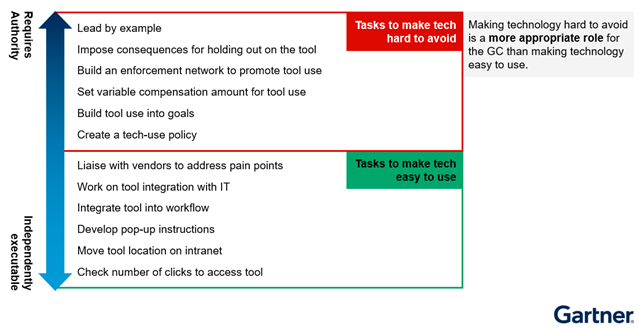
‘Making legal tech hard to avoid’ has low priority
Interestingly, Gartner identified that heads of legal hardly prioritise prevention of legal tech avoidance. While most GCs focus on selecting the presumed ‘right’ technology and making legal tech easy, and while legal leadership is well able to identify pain points in the available licensed legal tech solutions, and spends much effort on training users (each, 80% to 84%), hardly any priority is given to making legal tech hard to avoid (a mere 8%, 31% and 39% of possible actions).
Only 19% believe they are expected to use legal tech. Well, what can I say? End-users who do not perceive that they are expected to use tech? How do you expect them to adopt contract automation?
Only 13% feels consequences of no-adoption. I very much concur with the idea that negatively incentivising legal tech adoption might not sound appealing, but to give it this low priority, is another thing: there are always those who ‘get away’ with their undesired, avoidant behaviour. They might be the sceptics, but some scepticism is just in everyone’s mind – and it may not be helpful to cherish it.
Oh, and only 51% of general counsel create mandatory workflows that involve using technology…

Weagree, the elephant in the room?
We have always felt guilty about the all-too-often low adoption rates of Weagree, and very much feel responsible for a proper adoption rate. Indeed, Weagree has seen numerous extraordinarily successful customers and use cases. But there have also always been unsuccessful customers (not to mention those who failed completely in generating any return on their investment in us). And yes, even successful legal departments have their avoidant users.
Needless to say that for many years, We have spend countless hours figuring out how to improve adoption of our solution (user-friendliness!), to provide change management frameworks, and to interview both successful and unsuccessful customers on how to improve Weagree. These interviews are usually very concrete: walking through the application to see where Weagree’s user-friendliness fails. And needless to say that we prioritise fixing this and that we define our roadmap on such end-user feedback. And yes, we engaged Gartner (for a period of three years) to help us – to help you.
Whatever our end-users may say about how not-user-friendly or how not-intuitive our contract automation or CLM would be, we take the attitude that we must fix that. We do act upon feedback (he he, with our typically-large customers, it has made our Weagree Wizard extraordinarily flexible and led to an abundance of powerful CLM-features).
But the root cause for failed user adoption – the elephant in the room – appears to be elsewhere…

Tech-maturity saves 72 working days every year, per inhouse counsel
It appears that those legal departments that are on average at intermediate to advanced level of maturity, indicate 1.9 times more often that their adoption of legal tech is effective.
Only 23% of legal departments are ‘tech-ready’
The key cause of the excessive tech adoption failure rate relates to the legal department’s tech-readiness. Gartner identified that merely 23% of legal departments are ‘digitally ready’ (and indeed, the remaining 77% are not tech-ready). For a successful adoption of legal tech, it is crucial that three pillars on which the adoption of legal tech is to be based, are brought to the right maturity level:
- People (only 46% of legal counsel feels they are ready)
- Process (only 42% of legal counsel feels processes are optimised for tech)
- Data (only 39% of legal counsel feels the necessary data are in order)
Although people, process and data are somewhat intertwined with the technology as such; they are rather a prerequisite for stepping into effective use of tech.
These low readiness rates lead to the situation that only 43% of legal departments prioritise focus areas on the right parameters (being their internal client’s needs and the impact Legal can make). The easy argument is that the licensed legal tech solution is not fit (for them).
If 77% of legal departments are not mature, not ready to use contract automation or CLM effectively, how do you expect successful adoption?
What is tech-readiness?
Tech-readiness is a legal department’s weighted level of maturity in respect of each of the following legal operations (Legal Ops) competencies:
- Contract management
- IP management
- Change management and communication
- Strategic planning and Legal Ops leadership
- Project and process management
- Information governance (records management)
- Metrics and analytics (also capturing Rev Ops)
- Knowledge management
- Innovation management
- Technology management
- Financial management
- Internal resources management
- External resources management
We’ll address each of these competencies on another occasion. It is enough to emphasise that not all Legal Ops competencies need to be equally mature to start implementing legal tech. And some are more crucial than others for successful adoption.
How to make legal tech hard to avoid?
It is not all negative in this area. Gartner identified a number of actions an priorities for a general counsel to achieve greater adoption levels.
