

It wasn’t a club to say “bad, bad, bad.” Rather, the approach to lawyers was “You seem to be struggling. How can we provide more training, enrichment, and make this better?” When their new GC came in, no data was collected to make informed decisions. Available legal tech remained unused.
Gartner’s example
Let’s explore Gartner’s example of a completely failing legal tech implementation. The example they analysed was one of:
- Modern leadership (bottom up, consensus-oriented open discussions), where legal counsel and legal-ops managers were assigned a great level of autonomy and responsibility.
- Focus on simplifying and unifying contracting processes (with a strong, shared vision to adopting legal tech).
The org chart below of responsibilities in the analysed legal department was modern and appealing – even typical for nowadays’ organisations:

The above image looks great, doesn’t it? A great level of autonomy and responsibility assigned to the people who must do the job.
Yet, when workload and pressure on the legal department increased, the legal team agreed too quickly that the available legal technology was unfit (not user-friendly enough), and that hiring an interim legal professional would solve their immediate needs. Gartner analysed their case slightly differently..
They did not see the root cause
The team had no hesitation about the why of their work-overload, and how to relieve the immediate pressure. But they overlooked the root cause of their problem.
They had no actual data on their internal processes, no data on actual usage of the available technologies, no data on time spent on any matters, no data on individual steps of their processes, no data to compare one team member’s performance with that of a colleague; they had no data on anything. They did not involve the tech vendor to ‘dashboard’ such data or to support them in creating transparency.
The new GC required data (facts)
His incentive to collect data adequately was in his statement “I can’t help you solve this problem if I don’t have data to support that dialogue.” Team members fast became aware that insight in facts and the quality of the data was critical in convincing both their new GC and the business of any problems.
Historically, process improvements focus on immediate gains in productivity and response times. But prioritising improved data quality and facts-based insight in processes, will shift the focus to making existing processes more transparent, and more reliable regarding the quality of collected data.
The new GC not only required data as the basis for hiring an interim legal professional, he also demonstrated where the requested data was inadequate or not convincing (i.e. in the legal tech applications, in their registers).
Understandably so, because high-quality data are the foundation of an effective use of AI.
Collecting data require process monitoring
The legal counsel started analysing available data, analysed the ‘infrastructure’ from where data could be collected, they started to collect data, went on to improve the quality of the collected data, and in collaboration with their legal tech vendor, they added data points, analysed where data failed to come in or failed to be collected adequately.
The data infrastructure and transparency so created became a self-fulfilling prophecy for advanced data analytics. For a robust and reliable basis for improved decision making.
In the analysis of Gartner, what accelerates technology adoption is achieved by:
- Creating an accountability network of assigning responsibilities
- Requiring specific and enforceable actions from all stakeholders
- Defining roles clearly and leveraging natural (soft or implicit) sources of influence from all stakeholders
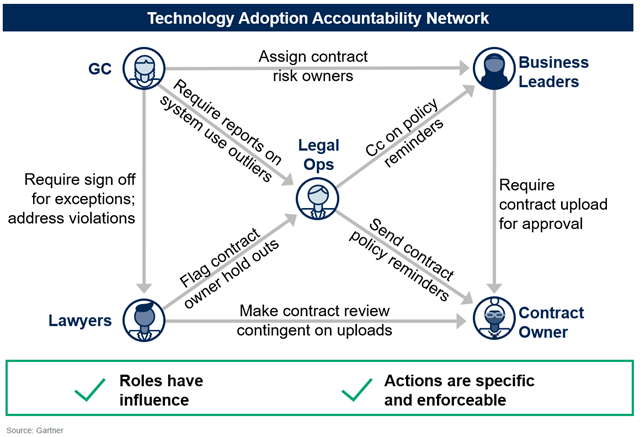
To explain how each stakeholder in the above-sketched ‘technology adoption accountability network’ contributes to significant business results is beyond the scope of this update. It requires a more integral adoption of legal tech, a more end-to-end solution, and closer alignment of legal with the business.
People, process and data
I am not generally an advocate of prioritising data collection or process redesign too much. I believe that technology should merge smoothly into existing processes, should naturally lead to increased insights and effective data collection… to improved (mature) legal ops. That is why Weagree has always focused on user-friendliness.
But falling back on ‘people’ – hiring more legal counsel for perceived-high workload – to solve a problem that is at the heart rooted in a defective or poor process or based on poor data (lack of insight or lack of transparency), clearly is old-school.
Are your three pillars of effective legal operations well-balanced?
