

When our launching customer ASML automated their Long-term supply agreements with Weagree, some 14 years ago, their legal department managed to speed up the contracting cycle from 12 to 18 months to as short as 2 to 5 months. This had a spectacular impact on their contracting processes – everyone ‘feels’ this.
A shorter transaction cycle is probably the single biggest benefit of contract automation. But how to quantify benefits from a shorter transaction cycle, from contract automation? Since Weagree was founded (19 years ago), the question of why a company should use Weagree has been a frequent point of reflection.
Faster contracting reduces the WACC
What is the monetary benefit of shortening a contract cycle? We asked this question to Anshul Gupta, one of the many experts we work with at Gartner. He needed no time to answer. A faster transaction cycle reduces the company’s ‘cost of capital’.
For example, if an average transaction cycle takes 8 weeks and contract automation accelerates the transaction to be completed in 6 weeks, then (on average) cash comes in 2 weeks earlier. Until the cash is received, certain activities need to be financed (if only the marketing, sales and legal teams). CFO’s use a well-known metric for this, the company’s ‘weighed average cost of capital’ (WACC). This example would translate into 25% saving on the company’s WACC, as it would take two out of eight weeks.
There are a few things to down-play this tremendous benefit: a transaction does not only consist of the contract cycle. It is part of a longer sales cycle (lead generation, customer acquisition, order processing and payment collection), so the eight weeks may be (much) longer. And it is not only this contract cycle on which a company build its operations. But still (the reduction achieved by our launching customer was much higher than two weeks).
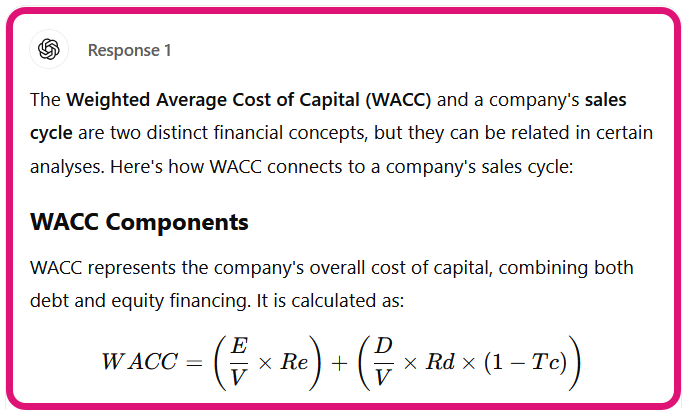
What’s the relevance of WACC?
To explore this further, ChatGPT was prompted to understand WACC and contracting cycles better. Also, a WACC-calculation is based on more components. First of all, the WACC and a company’s sales cycle are two distinct concepts. ChatGPT gave two lines of reasoning.
- Longer sales cycles may require more working capital to support operations, increasing the need for financing. And, if a company relies on debt to fund its sales cycle, its cost of capital (WACC) directly affects profitability.
- If a company finances sales growth through debt or equity, WACC determines the required return on investment (ROI).
- WACC impacts the pricing strategy – a business must price its products/services high enough to cover costs, including the cost of capital. A lower WACC allows for longer payment terms to customers – so a shorter contract cycle compensates for a long payment term.
- A company with a lower WACC has more flexibility in sales strategies, while a higher WACC may force stricter financial discipline in customer acquisition and payment terms.
There are many parameters like these that support a company’s overall strategic priorities.
Contract automation does not only relate to cost reduction (lowering the WACC), but may equally result in risk mitigation, higher profitability, growth, process optimisation, etc.
Regardless, you get the picture – the impact of short contracting cycles may be very significant. Prompt ChatGPT yourself to translate your company’s strategy to justify prioritising contract automation.
Want to discover how Weagree’s contract automation solution can benefit your organisation?
