

Adoption of legal tech is one of the largest challenges for any legal department. Research by Gartner shows that worldwide adoption rates of legal tech are dramatically low. Apparently, lawyers naturally tend to avoid legal tech.
Gartner’s research reveals that applications such as for matter management, document management, CLM (contract lifecycle management), contract creation and contract reporting are used by less than 25% of licensed users. Their market research also reveals that legal tech adoption potential tumbles by 50% if it’s easy to avoid.
Have you heard one or two of the excuses on the image below?
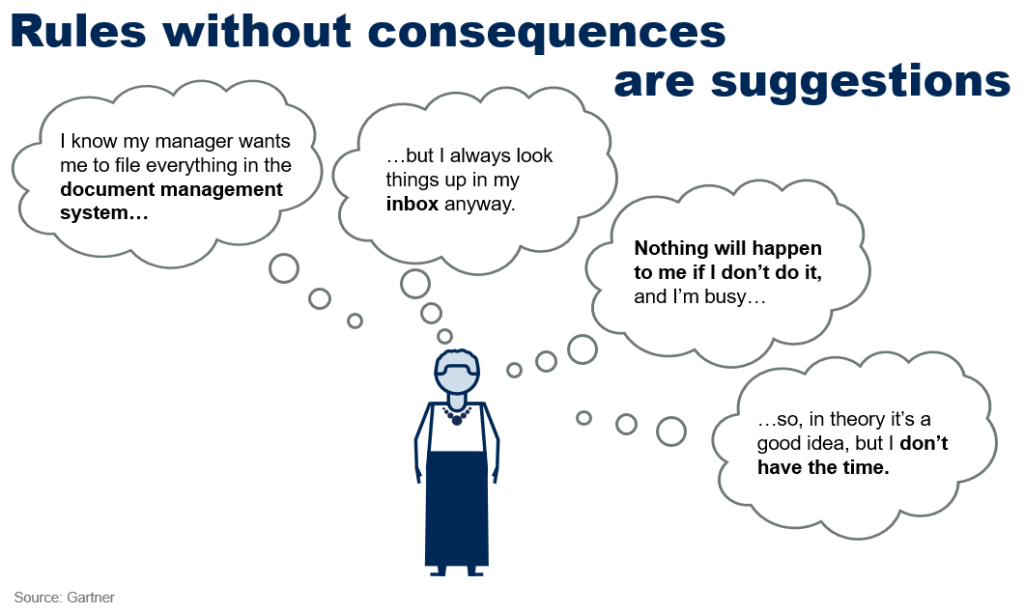
A dramatic reduction of adoption potential appears to correlate with enforcement of legal tech adoption (rules without soft or hard consequences are mere ‘suggestions’).
Power users vs. casual users
Gartner’s research shows that (potential) ‘power users’ require a different approach than ‘casual users’:
- For casual users, legal tech solutions must be simple, low-thresholded and intuitive.
- For power users, available features and options to expand usage might hardly be enough.
Starting with legal tech (or running up for power usage) should start small – that is a golden rule of change management. Also the opposite proves to be true: do not cut down the scope of a legal tech solution for those who should become power user.
In other words, enable potential power users to grow. A legal tech solution should facilitate both casual users and power users. This can be achieved by implementing an end-to-end solution that can – and will – be scaled up thanks to flexible ‘user management’: making functionalities available depending on the user’s journey.

How to exclude 75% from adopting
Gartner, the firm that advises us since early 2024, established that the legal tech adoption potential for a legal department reduces to less than 50% if the legal tech is easy to avoid. To put it cynically, for those lawyers who are typically from start to finish involved in contracting, a dramatic minimisation of adoption is easy to achieve.
A recipe for poor user adoption:
- Breaking up core contracting steps like transaction management (negotiation versions, matter management, document management), approval workflows, e-signing (incl. progress monitoring), tasks management, post-signing registration and obligations management into multiple applications.
- Adopting appealing AI tools that operate out of the organisation’s natural flow of data (i.e. not collecting or centralising contract data, but merely speeding up a contracting process step). After all, data management is one of the greatest challenges of successfully leveraging AI for the (RevOps) sales operations.
- Outsource part of the legal work instead of automating it.
Creating a scattered IT landscape of standalone legal tech tools makes adopting each tool difficult and each such tool easy to avoid.
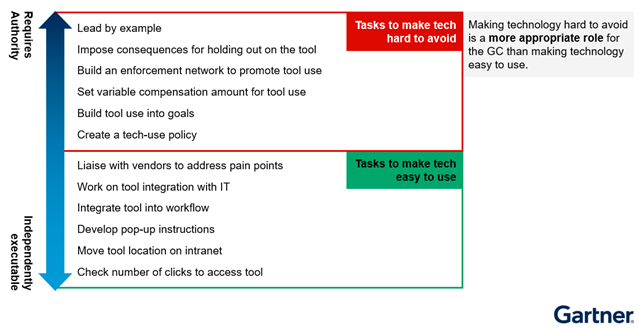
A much more effective approach is to implement an end-to-end platform. It makes legal tech harder to avoid.
If GC leadership fails
Just because a GC or head of legal says that technology is important, does not mean that lawyers hear it. Those involved in contracting have a lot of tasks and responsibilities, and prioritise their course of actions by following the GC’s example.
Gartner identified what makes legal tech ‘easy to avoid’ is the absence of enforcement: end users are inclined to adopt legal tech if actual legal tech usage contributes to visibility and quality of data, GC-perceived performance improvements. Not showing leadership, so GCs not showing their use of contract data or their steering on performance metrics, reduces adoption.
Easy to avoid = adoption potential tumbles
Fortunately, Gartner also identifies why adoption rates remain minimal (and how to improve it). Two key factors influence user adoption rates:
- Application is not easy to use.
- Application is not hard to avoid.
Yep: if legal tech is hard to avoid, then statistically, the adoption potential doubles. Last week, I discussed Gartner’s findings that making legal tech hard to avoid comes in grades: making it difficult to adopt can take many forms.
Also, as everyone knows, if a success story starts to resonate, more people will follow. It is therefore important to highlight (small) successes, and find the bright spots (avoid focusing on problems).
How to make legal tech hard to avoid?
It is not all negative in this area. Gartner advises that a GC addresses pain points with their CLM vendor, for example us:
